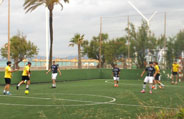
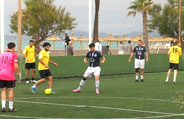
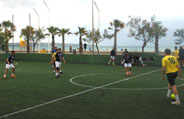
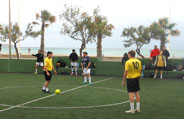
The
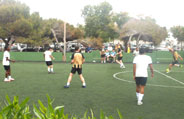
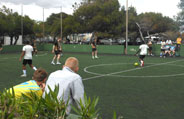
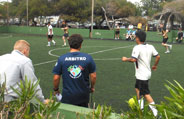
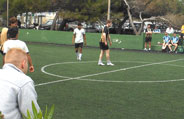
first Cup Semi-Final brought together Arenal and
RAF in a compelling Spain versus Portugal encounter,
with both sides arriving in excellent form. Arenal
had been one of the standout teams of the tournament,
winning all five of their matches, scoring 16
goals and conceding just once, underlining their
balance between attacking flair and defensive
solidity. RAF, meanwhile, had taken a more uneven
route into the semi-finals with three wins from
five, but their experience in reaching finals
in previous tournaments made them a dangerous
opponent despite their inconsistent group stage
record. With both sides confident in their ability,
a tightly contested affair was expected.
The
first half was a tactical battle, with RAF gradually
gaining control after an even opening spell. Arenal's
usually prolific attack found it difficult to
break down a well-organised Portuguese defence,
while RAF began to look increasingly threatening
on the counter. The breakthrough eventually came
for RAF through Diogo Goncalves, who gave his
side a crucial 1-0 lead. Despite Arenal's impressive
attacking record coming into the match, they were
unable to respond before half-time, leaving RAF
narrowly ahead at the break.
In
the second half, Arenal pushed forward in search
of an equaliser, but RAF remained disciplined
and compact defensively. Every attack from the
Spanish side was met with resistance, as RAF limited
clear chances and controlled the key moments of
the match. Arenal's usually free-scoring forward
line struggled to find rhythm against a defence
that rose to the occasion when it mattered most.
At
full-time, RAF held firm to secure a hard-fought
1-0 victory and book their place in the Cup Final.
It was a notable result given Arenal's dominant
tournament form up to that point, and a testament
to RAF's experience and game management in knockout
football. For Arenal, it was a rare setback in
an otherwise excellent campaign, as they exited
at the semi-final stage despite having been one
of the most impressive teams in the competition.
|
The
second Cup Semi-Final saw Ecuador 100% face Wentworth
Arms A for a place in the final against RAF, with
both sides carrying strong momentum into the tie.
Ecuador arrived with a formidable record in the
competition, having consistently been among the
tournament's most dominant teams in recent years
and aiming for a fourth title in five seasons.
Wentworth Arms A, meanwhile, were enjoying their
best-ever run in Mallorca, reaching the semi-finals
for the first time after an impressive 2-1 win
over Deportivo Dooradoyle in the previous round.
Although Ecuador had previously beaten Wentworth
Arms B heavily in 2024, this A-team encounter
was expected to be a far more competitive contest.
The
match began with Ecuador 100% quickly asserting
their attacking authority, as they so often had
throughout the tournament. Kennet opened the scoring
to give the South Americans an early advantage,
before Estiven Lastra added his 11th goal of the
day to double the lead before half-time. Wentworth
Arms A worked hard to stay in the contest, but
Ecuador's movement and finishing quality ensured
they went into the break firmly in control at
2-0.
After
the restart, Ecuador looked to have settled the
tie when Lastra struck again to make it 3-0, seemingly
putting the game beyond reach. However, Wentworth
Arms A responded with real resilience, led by
Phil King, who continued his outstanding scoring
run with his seventh goal of the tournament to
reduce the deficit to 3-1. He struck again soon
after to make it 3-2, setting up a tense final
phase as the English side pushed for an equaliser
that would have forced penalties.
Ultimately,
Ecuador's quality in key moments proved decisive,
and Estiven Lastra once again delivered when his
team needed him most, scoring his 13th goal of
the day to restore the two-goal cushion at 4-2.
That strike effectively sealed the contest, sending
Ecuador 100% through to the final after a high-quality
and fiercely competitive semi-final. Wentworth
Arms A exited the tournament with pride after
their best-ever Mallorca campaign, having pushed
one of the competition's strongest sides further
than most, while Ecuador advanced to another final
in their quest for more silverware.
|